
You are currently viewing Is the AI Boom a Bubble? Behavioural Economics Explains the Truth

Is the AI Boom a Bubble? Behavioural Economics Explains the Truth

AI bubble concerns surround the current AI boom, yet economics classrooms often start with clean theories that depict perfect markets, perfect information, and perfect choices. This idealised state is what many of us desire, but it does not exist outside the pages of textbooks.

Our economic models often rely on the fictional character of homo economicus, an entirely logical human who calmly weighs every option and acts solely out of self-interest. Highlighting that this type of human species has never actually existed on Earth helps readers understand the gap between theory and reality. If he had, we would never make assumptions about a theory in action that are mostly disconnected from reality. The same goes for the AI boom, where many people suspect a bubble.

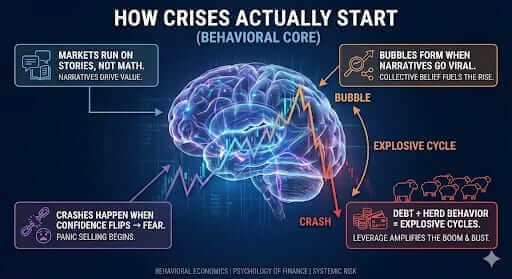
The real world is messy, emotional, and uncertain. It is full of surprises. Nevertheless, People panic suddenly. They follow the crowd. They make decisions based on fear, stories, moods, and shortcuts. If people behaved in the same way, the person who knows how they behave would have become the emperor of this world without much effort.

Since economies are driven by human behaviour rather than flawless equations, understanding how emotions and biases influence markets is crucial for grasping bubbles and crashes. Recognising that emotional reactions can trigger market shifts helps readers see why behavioural economics is vital. 

This is precisely why heterodox economics and behavioural economics matter. They study the world as it is full of biases, emotions, rumours, status anxiety, herd instinct, and hope. Markets move first because people move. Data only catches up later.

A Crash Begins with Doubt

A crash never begins with GDP.

It begins with doubt.

Richard Thaler captured this pattern sharply in Misbehaving:

“It is impossible to dismiss the series of booms, bubbles, and crashes we have observed… stock prices fell more than 20% around the world in the absence of any substantive bad news… followed by a tech bubble, then a housing bubble, then a global financial crisis.”
— Richard Thaler

Thaler’s point is simple: markets do not wait for evidence; they respond to moods. Prices move on fear, narratives, and expectations long before official indicators confirm a downturn—just as seen during the rapid sell-off ahead of the 2008 global financial crisis.

Yuval Noah Harari warns similarly in Sapiens which is very much relevant to current AI BUBBLE:

" Banks and governments created trillions out of thin air, hoping scientists and engineers will come up with something big before the bubble bursts… if the labs fail to deliver, we are heading towards rough times."
Yuval Noah Harari
Israeli medievalist and military historian

A Early Warning Signals: Behaviour Shows Stress Before Data Does

Heterodox macro lens

India’s Early Warning Signals

Behaviour often shows stress before official data does. These indicators track everyday spending patterns that can hint at downturns earlier than headline numbers.

Signal #1

Men’s Underwear Index

The idea: when households sense tough times ahead, they defer low-visibility essentials like undergarments because delaying them doesn’t affect social appearance. In India, where consumer confidence strongly shapes discretionary spending, a softening in such “quiet essentials” can be an early stress hint.

What to watch Volume/discounting spikes, downtrading, longer replacement cycles
Why it matters Private caution tends to appear before macro confirmation
Signal #2

Lipstick-to-Less Trend

In mild distress, people cut big-ticket luxuries but still keep “small treats” (lipstick, perfumes, budget makeup). When even these small indulgences decline, it suggests confidence has cracked — not just postponed.

What to watch Declines in low-cost indulgence categories + fewer impulse purchases
Interpretation Shift from “manage stress” spending to “survival” spending
Signal #3

Cardboard Box Indicator

A drop in demand for cardboard cartons can be an early “calm before the storm” sign: fewer boxes often implies fewer shipments, fewer orders, and a slowdown in purchasing volume. In urban India, this is especially relevant with food delivery and e-commerce packaging.

What to watch Packaging orders, logistics volumes, delivery frequency, box prices
Why it matters It’s a proxy for real activity before GDP revisions arrive

Note: These are directional signals, not standalone proof. They work best when tracked together and compared with broader indicators (employment stress, credit behaviour, and business sentiment).

.

Heterodox economics teaches one thing clearly: understanding how everyday behaviour signals stress helps predict economic downturns before official data confirms it. The same applies to the AI Bubble scenario.

Here are the world’s most telling behavioural indicators, serving as early warning signals of economic stress, helping economists anticipate downturns before official data confirm them, thereby enabling proactive measures.

  1. Men’s Underwear Index

The men’s underwear index has been recognised as an early warning indicator of recession or economic downturns. It assumes that men tend to defer purchasing undergarments when they feel tough times are ahead. This indicator is based on the assumption that undergarments and stockings are not visible to others, prompting men to delay purchases when they perceive a promising future. Across the world, where consumer spending patterns are closely linked to economic confidence, this index offers valuable insights into upcoming downturns

2. Lipstick-to-Less Trend

 In times of distress, people stop buying high-end luxury goods but still buy small treats (lipstick, perfume, budget makeup). When even these drop, confidence is broken.

3. Cardboard box indicator

A decline in the demand for cardboard cartons may signal an early warning of a calm before the storm. This is based on the assumption that a decrease in demand for
Cardboard boxes can indirectly indicate a reduction in overall purchasing volume, which may indicate a recession ahead. This indicator holds
particular significance in a country like India, where a large portion of the urban population relies on food delivery services like Swiggy and purchasesgoods online, many of which are packaged in cardboard boxes.

The AI Boom Through India's Eyes

rare earth race
Why AI Is So Expensive?: Jevons Paradox in Action

Why AI Is So Expensive

Jevons Paradox in Action

Economist William Jevons discovered something strange in the 19th century:

When a technology becomes more efficient, total usage increases so fast that total cost rises—not falls.

This is happening in AI. As models get faster and cheaper per query, people use them more, pushing total compute, electricity, and infrastructure requirements to extreme levels. These rising infrastructure costs explain why the AI bubble appears inflated even when demand is genuine. OpenAI alone is estimated to spend tens of billions per year just to run its models.

This is not typical software. This is closer to running power plants. For India, this matters because the cost of computing will determine whether AI becomes truly democratic or remains elite.

The Dotcom Parallel

The current surge in AI funding closely mirrors the speculative patterns of the dotcom bubble. Unlike the dotcom era, today’s AI bubble debate often ignores existing adoption and real output. In the late 1990s, companies added ".com" to their names to secure capital despite having no viable revenue models, leading to a market crash that wiped out $5 trillion in value by 2002.

At the time, investors ignored traditional metrics such as price-earnings ratios in favour of "get big fast" strategies, and most startups failed once capital ran dry. We see a comparable trend in 2025, where AI-labelled startups captured 58% of global venture capital in the first quarter alone, totalling $73.1 billion.

Much like the dotcom era's focus on branding over substance, 73% of examined AI startups exaggerated their capabilities by wrapping open-source models rather than building proprietary technology.

Revenue vs. Profitability

While leading AI firms have demonstrated explosive top-line growth, profitability remains a critical challenge due to structural cost burdens.

  • OpenAI reported annualised revenue of $13 billion by August 2025, a massive leap from $200 million in 2023.
  • C3.ai saw a 25% year-over-year revenue increase to $389.1 million.

However, this growth often masks underlying financial fragility. Many AI startups operate with average gross margins of just 25%, which is significantly lower than the 75% benchmarks of traditional SaaS, due to the intense costs of compute and data inference.

Consequently, despite attracting $89.4 billion in global venture capital in 2025, widespread profitability remains elusive as firms prioritise scaling and market share over sustainable margins.

AI is the new symbol of hope, fear, and speculation. However, India stands like a Hercules, protecting the world from an AI bubble, thanks to its youth, making it the world's most extensive potential AI user base. India’s scale and real-world usage act as a buffer against an AI bubble driven purely by speculation. No wonder AI companies around the globe are fighting to offer generous free tiers to Indians.

Even though India currently lags global leaders in AI model development, ISRO, India's premier space organisation, develops rockets at a fraction of the cost of its American counterparts. India can win the AI race with the same strategy only if we can retain the talented engineers who are getting laid off to build our own Desi Deepseek moment. It will be possible if and only if the government provides them with ample incentives to do so. This highlights significant growth opportunities and the importance of understanding the global situation.

Now, let us examine the global AI Mania. Two numbers matter:

  • OpenAI valuation: $500 billion
  • Productive AI usage globally: less than 5%

Most people do not use AI meaningfully yet. Most companies have not integrated AI into real workflows. The promise is massive, but adoption is slow.

Why the AI Boom Will Not Crash Like the Dotcom Bubble

Many people compare the AI moment to the dotcom crash of 2000. However, the comparison is flawed. Here’s why:


Chinese AI labs (such as Moonshot, Baidu, Alibaba, and Zhipu) build powerful models at a fraction of the cost in the US.

For example:

Kimi K2 reportedly cost only a few million dollars to train, compared with the billions spent on models such as GPT-4 and GPT-5.

This global cost competition protects the world from hype-driven overvaluation.

Indian startups increasingly rely on Chinese open-source models because they are:

  • cheaper
  • easier to run
  • less compute-heavy
  • good enough for real business tasks

This naturally prevents a bubble from inflating uncontrollably, keeping prices in check.

otcom companies had websites and ideas, but no real-world use cases. AI is different; it is fast, efficient, and cheap.

AI is automating hospital records, grading produce on farms, detecting fraud in banks, or finding the next multibagger stock,or predicting whether a stock is overvalued, preventing a bubble using AI and building tools for kirana stores and students.

India sees AI adoption in:

  • UPI security
  • Aadhaar service delivery
  • education tutoring
  • logistics optimisation
  • vernacular chatbots

This is real output, not speculative fantasy.

Inexperienced investors and easy IPOs fueled the Dotcom.

AI is backed by giants with decades of cash flow: Microsoft, Google, and Amazon.

They can burn money for a decade. While1990s dot -com companies could not.

Dotcom had thousands of low-quality startups.

AI requires:

  • world-class talent
  • vast compute
  • deep research
  • strict regulation

This prevents a flood of weak companies.Strong entry barriers reduce the risk of an AI bubble collapsing suddenly.

The result is a slower, more stable, but volatile growth cycle—not a dramatic bubble followed by collapse.

However, it would be reasonable to assume that such a bubble burst would create new industry leaders, just as Google and Apple survived the dotcom crash.

So, Are We in a Bubble or Not?

AI valuations are high.

Costs are rising.

Expectations are unrealistic.

However, the foundation is strong.

We will see corrections, not collapse.

We will see volatility, not disaster.

We will see slower adoption followed by sudden leaps.

For India, it is an ocean of opportunities. Here is why

  • large young population
  • low cost of adoption
  • rapid digital comfort
  • practical mindset
  • massive service-sector base

Even if global AI valuations wobble, India benefits from lower-cost open-source models and broad user adoption.

This is why the current AI bubble looks more like a hype wave than a systemic failure

Final Take: Behaviour Explains More Than Equations

Real economies never follow textbook theories because real people do not behave like perfect calculators.

Behaviour shifts first.

Markets follow behaviour.

Data comes last.

Understanding behaviour clarifies why every AI bubble fear follows familiar human patterns.

Once we accept that:

  • bubbles make sense
  • crashes make sense
  • corrections make sense
  • AI’s wild ride makes sense

The AI moment is not a mystery.

It is simply the old wine in a new bottle.

where human hope runs ahead of reality, and reality catches up slowly.

That is how economies rise and fall.

The AI Bubble: A Behavioral Economics Perspective
AI bubble analysis and market trends

Why Behavior Drives Every Boom and Bust

Economics classrooms often start with clean theories that depict perfect markets, perfect information, and perfect choices. This idealised state is what many of us desire, but it does not exist outside the pages of textbooks. Our economic models often rely on the fictional character of homo economicus, an entirely logical human who calmly weighs every option and acts solely out of self-interest.

Highlighting that this type of human species has never actually existed on Earth helps readers understand the gap between theory and reality. If he had, we would never make assumptions about a theory in action that are mostly disconnected from reality. The real world is messy, emotional, uncertain, and full of surprises. Nevertheless, people panic suddenly. They follow the crowd. They make decisions based on fear, stories, moods, and shortcuts.

Since economies are driven by human behaviour rather than flawless equations, understanding how emotions and biases influence markets is crucial for grasping bubbles and crashes. This is precisely why heterodox economics and behavioural economics matter. They study the world as it is—full of biases, emotions, rumours, status anxiety, herd instinct, and hope. Markets move first because people move. Data only catches up later.

A Crash Never Begins with GDP

It begins with doubt. Richard Thaler captured this pattern sharply in Misbehaving:

"It is impossible to dismiss the series of booms, bubbles, and crashes we have observed… stock prices fell more than 20% around the world in the absence of any substantive bad news… followed by a tech bubble, then a housing bubble, then a global financial crisis."

Thaler's point is simple: markets do not wait for evidence; they respond to moods, such as the rapid sell-off during the 2008 financial crisis, even before precise data confirmed the downturn.

Yuval Noah Harari warns similarly in Sapiens: "Banks and governments created trillions out of thin air, hoping scientists and engineers will come up with something big before the bubble bursts… if the labs fail to deliver, we are heading towards rough times." Today, the "labs" are AI labs. The expectation is enormous.

India's Early Warning Signals

Heterodox economics teaches one thing clearly: understanding how everyday behaviour signals stress helps predict economic downturns before official data confirms it.

1. Men's Underwear Index

The men's underwear index has been recognised as an early warning indicator of recession or economic downturns. It assumes that men tend to defer purchasing undergarments when they feel tough times are ahead. In India, where consumer spending patterns are closely linked to economic confidence, this index offers valuable insights into upcoming downturns.

2. Lipstick-to-Less Trend

In mild distress, people stop buying big luxury goods but still buy small treats (lipstick, perfumes, budget makeup). When even these drop, confidence is broken.

3. Cardboard Box Indicator

A decline in the demand for cardboard cartons may signal an early warning sign of a calm before the storm. This is based on the assumption that a decrease in demand for cardboard boxes can indirectly indicate a reduction in overall purchasing volume.

The AI Boom Through India's Eyes

AI is the new symbol of hope, fear, and speculation. However, India stands like a Hercules, protecting the world from an AI bubble, thanks to its youth, making it the world's most extensive potential AI user base. India’s scale and real-world usage act as a buffer against an AI bubble driven purely by speculation. No wonder AI companies around the globe are fighting to offer generous free tiers to Indians.

Even though India currently lags global leaders in AI model development, ISRO, India's premier space organisation, develops rockets at a fraction of the cost of its American counterparts. India can win the AI race with the same strategy only if we can retain the talented engineers who are getting laid off to build our own Desi Deepseek moment. It will be possible if and only if the government provides them with ample incentives to do so. This highlights significant growth opportunities and the importance of understanding the global situation.

Now, let us examine the global AI Mania. Two numbers matter:

  • OpenAI valuation: $500 billion
  • Productive AI usage globally: less than 5%

Most people do not use AI meaningfully yet. Most companies have not integrated AI into real workflows. The promise is massive, but adoption is slow.

Why AI Is So Expensive (Jevons Paradox in Action)

Economist William Jevons discovered something strange in the 19th century: When a technology becomes more efficient, total usage increases so fast that total cost rises—not falls. This is happening in AI.

As models get faster and cheaper per query, people use them more, pushing total compute, electricity, and infrastructure requirements to extreme levels. These rising infrastructure costs explain why the AI bubble appears inflated even when demand is genuine. OpenAI alone is estimated to spend tens of billions per year just to run its models.

This is not typical software. This is closer to running power plants. For India, this matters because the cost of computing will determine whether AI becomes truly democratic or remains elite.

The current surge in AI funding closely mirrors the speculative patterns of the dotcom bubble. Unlike the dotcom era, today’s AI bubble debate often ignores existing adoption and real output. In the late 1990s, companies added ".com" to their names to secure capital despite having no viable revenue models, leading to a market crash that wiped out $5 trillion in value by 2002.

We see a comparable trend in 2025, where AI-labelled startups captured 58% of global venture capital in the first quarter alone, totalling $73.1 billion. While leading AI firms have demonstrated explosive top-line growth, profitability remains a critical challenge due to structural cost burdens. Consequently, despite attracting $89.4 billion in global venture capital in 2025, widespread profitability remains elusive.

Why the AI Boom Will Not Crash Like the Dotcom Bubble

Many people compare the AI moment to the dotcom crash of 2000. However, the comparison is flawed.

1. Chinese Open-Source AI Keeps Prices Honest

Chinese AI labs build powerful models at a fraction of the cost in the US. For example, Kimi K2 reportedly cost only a few million dollars to train compared to the billions spent on models like GPT-4 and GPT-5. This global cost competition protects the world from hype-driven overvaluation. Indian startups increasingly rely on Chinese open-source models because they are cheaper and easier to run. This naturally prevents a bubble from inflating uncontrollably.

2. AI Already Has Real-World Use

Dotcom companies had websites and ideas, but no real-world use cases. AI is different; it is fast, efficient, and cheap. AI is automating hospital records and detecting fraud in banks. India sees AI adoption in UPI security, Aadhaar service delivery, and vernacular chatbots. This is real output, not speculative fantasy.

3. Investors Today Are Stronger and Wiser

Inexperienced investors and easy IPOs fueled the Dotcom. AI is backed by giants with decades of cash flow: Microsoft, Google, and Amazon. They can burn money for a decade.

4. AI Has Very High Entry Barriers

Dotcom had thousands of low-quality startups. AI requires world-class talent, vast compute, and deep research. Strong entry barriers reduce the risk of an AI bubble collapsing suddenly.

So, Are We in a Bubble or Not?

We are in a hype wave, not a bubble. AI valuations are high, costs are rising, and expectations are unrealistic. However, the foundation is strong. This is why the current AI bubble looks more like a hype wave than a systemic failure. We will see corrections, not collapse.

For India, it is an ocean of opportunities. Even if global AI valuations wobble, India benefits from lower-cost open-source models and broad user adoption.

Final Take: Behaviour Explains More Than Equations

Real economies never follow textbook theories because real people do not behave like perfect calculators. Behaviour shifts first. Markets follow behaviour. Once we accept that bubbles, crashes, and corrections make sense, the AI moment is not a mystery.

It is simply the old wine in a new bottle, where human hope runs ahead of reality, and reality catches up slowly. Understanding behaviour clarifies why every AI bubble fear follows familiar human patterns. That is how economies rise and fall.

Further Reading

Ashin S Anish

Mr. Ashin S. Anish is a dynamic financial market analyst with a rich portfolio of global certifications and expertise. He brings together a unique blend of skills spanning finance, risk management, cybersecurity, and artificial intelligence. • Certified in Financial Markets from the Indian School of Business (ISB) • Certified Money Manager from the University of California, Irvine • Cybersecurity Tools & Cyberattacks Specialist certified by IBM • Certified in Artificial Intelligence from DeepLearning.AI • Certified in Portfolio and Risk Management from the University of Geneva • Certified in Microeconomics Principles from the University of Illinois Currently, he is pursuing his PhD in Economics at Jawaharlal Nehru University (JNU), under the Centre for Development Studies, Trivandrum, where his research bridges theory and practice in today’s fast-changing global economy. Beyond academics and credentials, Ashin is an avid money manager who believes: “In money matters, you must be as agile and adaptive as a monkey — quick to spot opportunities and flexible in managing risks.”

Leave a Reply