

Trump has been shaking the world with his announcement of new tariffs. Many economists worry that this could disrupt the economy and the global order. At the same time, Trump claims that his move is going to “Make America Great Again.”
But how far is this dream from reality?
Will his tariff bomb really bring manufacturing hubs back to the USA from China and Vietnam?
What changes will it bring to the world economy?
Is it an effective economic policy or simply a political tool?
This article explores these questions in detail. Join us as we navigate the complex world of Trump’s tariffs.
Table of Contents
What is a tariff in the first place?
Edward Elgar (2015) defines a tariff as a” tax imposed on imported goods, typically collected by customs officials at the border and paid by the domestic buyer. Tariffs are intended to protect domestic industries from foreign competition and generate revenue for the government. They can vary across sectors and products, and economists widely agree that high tariffs damage overall economic efficiency by distorting prices and resource allocation”.
But Trump understands tariffs differently. In Peters’ overview of ‘Trump’s Tariffs,’ tariffs are described as taxes on imports paid by domestic buyers and collected by U.S. Customs, with proceeds going to the Treasury; they are used both to raise revenue and to make imports more expensive to benefit domestic producers.
The immediate impact of these tariffs on domestic buyers cannot be understated.
The article frames Trump’s stance as viewing tariffs as a remedy against ‘dishonest trade practices’ such as subsidies or currency manipulation. These practices, according to Trump, unfairly advantage foreign producers and harm American businesses.
Therefore, tariffs are seen as a way to level the playing field, protect specific U.S. industries and jobs, and encourage consumers and firms to buy American and ditch foreign goods.
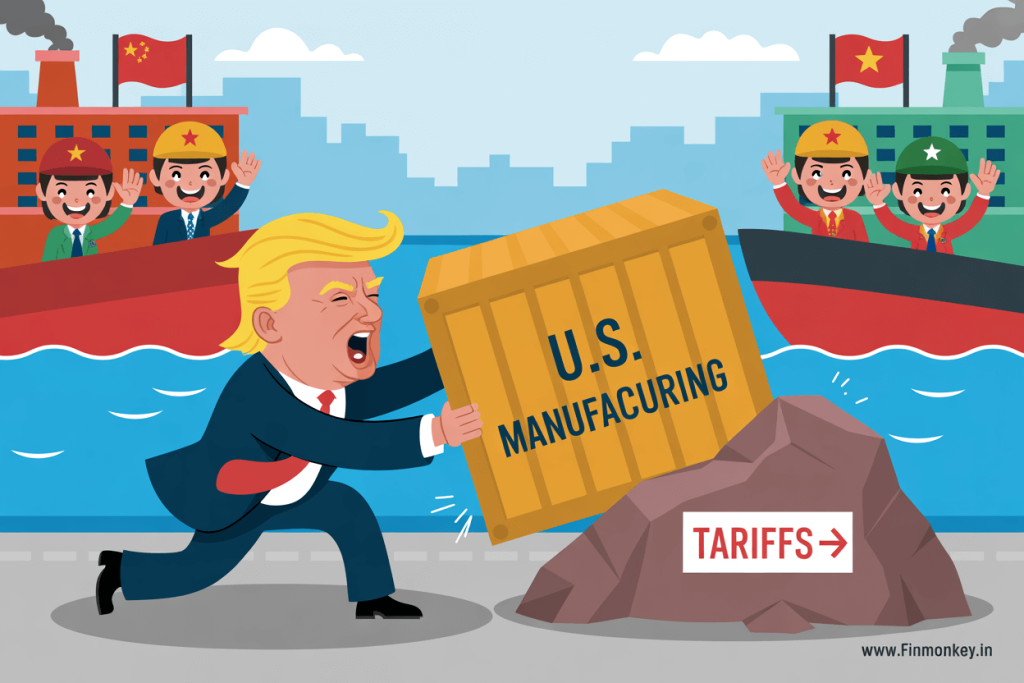
However, this reasoning appears deeply flawed and unlikely to deliver the promised results. Rising production costs pose a significant challenge, as these are ultimately passed on to consumers, reducing their purchasing power. U.S. companies that previously relied on outsourcing now face the difficulty of securing skilled labor for assembly-level jobs at much higher wages—especially in a labor market where unemployment was just 4.3% in August 2025, indicating a scarcity of affordable workers. In effect, these tariffs act as a bottleneck, obstructing companies’ plans to shift production back to the U.S.
The vision of defeating China and restoring the U.S. as a global manufacturing powerhouse is therefore less a realistic strategy and more akin to a one-sided love story. There are several reasons why these tariffs may not achieve their intended outcomes. Trump’s trade policies are rooted in a series of fundamental economic fallacies, which have resulted in interventions that weakened economic efficiency, curtailed job growth, and eroded global competitiveness. It is crucial to critically examine these fallacies to fully grasp the potential consequences of Trump’s tariffs—and to recognize the urgent need for policies that strengthen, rather than undermine, the U.S. economy.
1. The Fallacy of Trade as a Zero-Sum Game:
At the core of the Trump administration’s trade philosophy was the belief that international trade is a zero-sum game. This means they believed that one country’s economic gain in trade necessarily comes at the expense of another’s loss.
To put it simply, they thought that if one country wins, another must lose. This directly contradicts classical and modern economic theory, which overwhelmingly views trade as a positive-sum process.
Economists widely agree that trade benefits all participating nations through specialisation, where countries focus on producing goods and services they are most efficient at.
This is known as ‘comparative advantage’, a concept first introduced by David Ricardo in 1817. Even if one country excels in a particular area, both countries still benefit from trading based on relative efficiency.

David Ricardo
David Ricardo (18 April 1772 – 11 September 1823) was a British economist and politician. He is recognized as one of the most influential classical economists.
The administration’s framing, however, led to protectionist interventions, such as tariffs, that disrupted established global supply chains and diminished overall economic efficiency, as countries were incentivised to produce goods less efficiently domestically rather than import them.
2. The Fallacy that Tariffs Safeguard Jobs and Shrink Trade Deficits
A primary stated rationale for imposing tariffs was to safeguard domestic jobs and rectify trade imbalances, specifically the U.S. trade deficit. However, the anticipated boom in the domestic industry remained largely elusive. While specific sectors like steel and aluminium producers experienced some short-term gains, these were significantly overshadowed by losses in downstream industries that relied on these inputs.
For instance, approximately 75,000 manufacturing jobs were lost in 2018 alone in industries dependent on steel and aluminium.
The data indicated a stark imbalance: for every steel job gained, approximately 80 downstream jobs were lost, and for aluminium, this figure rose to 177 jobs.
This imbalance highlights the fallacy that tariffs primarily protect domestic jobs and reduce trade deficits, as the actual impact is more complex and often leads to job losses in other sectors.
Furthermore, tariffs largely failed to deliver sustained factory job growth, partly due to existing workforce shortages that constrained domestic production capacity even with increased demand.
A central aim of the policies was to reduce the U.S. trade deficit significantly.
Despite these efforts, the trade deficit proved stubbornly high, reaching $918 billion (3.1% of GDP) by December 2024, and the overall U.S. trade deficit surged to $576 billion in 2019, marking the highest level since 2008.
Economic analyses consistently indicate that trade deficits primarily persist due to underlying macroeconomic imbalances
Trump also believed that a trade deficit is undesirable for the economy, forgetting that the US has maintained stable economic growth despite a high trade deficit, thanks to a substantial amount of FDI flowing to the US.
A deficit ideally means that people are willing to buy more than they can afford, which is a green flag on the economy. Trade deficits should only be a concern if the deficit rises uncontrollably high or is not being matched by a substantial amount of foreign reserves.
U.S. Trade Balance Benchmarks (1970 → 2025)
Goods & services, nominal USD billions. Representative decade benchmarks and recent years, with a mid-year snapshot for 2025.
| Year | Exports (USD bn) | Imports (USD bn) | Trade Balance (USD bn) | Status |
|---|---|---|---|---|
| 1970 | 43.2 | 42.8 | +0.4 | Surplus |
| 1975 | 96.2 | 94.3 | +1.9 | Surplus |
| 1980 | 220.6 | 241.2 | −20.6 | Deficit |
| 1985 | 219.7 | 319.2 | −99.5 | Deficit |
| 1990 | 392.7 | 491.6 | −98.9 | Deficit |
| 2000 | 783.8 | 1,202.3 | −418.5 | Deficit |
| 2010 | 1,838.6 | 2,343.9 | −505.3 | Deficit |
| 2020 | 1,430.0 | 2,331.5 | −901.5 | Deficit |
| 2022 | 2,070.6 | 3,015.1 | −944.5 | Deficit |
| 2024 | 2,104.2 | 3,022.6 | −918.4 | Deficit |
| 2025* | 1,251.9 | 2,058.4 | −806.5 | Deficit |
- Surplus ended after 1975; the U.S. has run persistent trade deficits since the early 1980s.
- The deficit first exceeded $400 billion in 2000 and has approached $1 trillion in recent years.
- * 2025 reflects January–July cumulative data.
For complete, year-by-year detail, see official spreadsheets from the Bureau of Economic Analysis and the U.S. Census Bureau, and the Statista page on the total value of the U.S. trade balance since 2000: Statista – U.S. Trade Balance Since 2000.
Africa — Recent Trade Balance Highlights
Summarised, most-recent readings (where available). Values shown in million units and reported in local currency or USD as indicated.
| Country | Recent Trade Balance | Currency | Status | Notable Trend |
|---|---|---|---|---|
| 🇿🇦 South Africa Jun 2025 | 22,040 | ZAR Million | ▲ Positive | Generally positive, export-led growth |
| 🇦🇴 Angola Mar 2025 | 3,972 | USD Million | ▲ Positive | Resource exports drive surplus |
| 🇱🇾 Libya Dec 2023 | 66,628 | LYD Million | ▲ Positive | Oil export surplus |
| 🇪🇬 Egypt May 2025 | −3,413 | USD Million | ▼ Negative | Import-heavy economy |
| 🇲🇬 Madagascar Jun 2024 | −847 | MGA Million | ▼ Negative | Trade deficit persists |
| 🇸🇱 Sierra Leone Mar 2025 | −75.56 | USD Million | ▼ Negative | Limited export diversification |
| 🇬🇭 Ghana Jun 2025 | 720 | USD Million | ▲ Positive | Modest surplus |
| 🇳🇬 Nigeria Mar 2025 | 1,993,619 | NGN Million | ▲ Positive | Large oil export surplus |
⚠️ Note: Values are in million units and shown in either local currency or USD as indicated; they are not directly comparable across countries without conversion and seasonal/terms-of-trade adjustments.
For deeper context, pair this with your U.S. trade balance section and, where available, link to each country’s statistical releases or central bank bulletins.
Trade balances fluctuated across countries, with resource-rich economies generally maintaining positive balances and less diversified economies facing consistent deficits.
Over the last 50 years, many African countries have oscillated between periods of positive and negative trade balances, depending on commodity prices, political stability, and economic Reforms.
Trump is ignoring this fact: we cannot always maintain a trade surplus with all nations, as the mercantilist school suggests. Instead, nations engage in trade to export goods in which they have a comparative advantage and import goods where they can get the best deal.
But Trump’s idea of tariffs completely shakes this concept.
3. The Fallacy that Tariffs Do Not Harm Consumers and Allied Industries
The administration often downplayed the negative impact of tariffs on American consumers and allied industries, but these policies effectively functioned as a hidden tax on American households. Consumers faced significantly higher prices for a wide range of goods.
Estimates suggested that households would pay an additional $1,200 per year due to tariffs on major trade partners by 2025.
Imported goods became approximately 5% more expensive, and domestic prices saw a 3% increase by mid-2025 as producers passed on increased costs or as domestic alternatives became more expensive due to reduced competition.
Industries heavily reliant on imported inputs, such as the automotive, construction, and machinery sectors, experienced sharp increases in their operational costs.
For example, a 25% tariff on steel could add up to $2,000 to the cost of producing a single vehicle. Major corporations, such as Caterpillar, reported absorbing an additional $100 million in costs in 2018 alone due to these tariffs, which ultimately impacted their profitability and investment capacity.
Tariffs acted like a tax on American households. The Peterson Institute for International Economics (2019) estimated that tariffs cost households $831 per year, later rising to $1,200+ by 2025.
For example, tariffs on washing machines in 2018 raised prices by 12%, costing U.S. consumers $1.5 billion extra (Flaaen, Hortaçsu, & Tintelnot, 2019).OECD (2025) projected U.S. inflation at 2.8%, partly driven by the proposed tariffs.IMF (2020) estimated tariffs would shave 0.3–0.4% off U.S. GDP in the medium term.
Investments are expected to be weakened due to uncertainty, especially in global supply chains, with firms shifting production to Vietnam, India, and Mexico (Bown, 2020)
4. The Fallacy of Enhancing U.S. Global Competitiveness Through Protectionism
Instead of bolstering U.S. global competitiveness, the imposed tariffs ironically eroded export competitiveness and disrupted established global value chains, partly due to the pervasive policy uncertainty they created.
American farmers, in particular, bore a heavy burden, losing up to $27 billion in export revenue as a direct consequence of retaliatory tariffs imposed by China.
These protectionist policies also inflicted significant collateral damage on key U.S. allies, including Canada, Mexico, and the European Union. The imposition of tariffs on these traditional partners provoked retaliation and strained diplomatic and economic relations, leading to a significant slowdown in global trade volume growth.
Furthermore, rather than encouraging reshoring or nearshoring of manufacturing to the U.S., many firms increasingly opted to relocate their operations to other countries, such as Vietnam, India, and Mexico, in an effort to circumvent tariffs and maintain cost-effectiveness.
This trend inadvertently weakened U.S. supply chains rather than strengthening them. To make things worse trump didnt think of the fact that different intermediate goods has to be imported from diffrent countries and a tariff on them will only be like pouring water into a broken glass.
The Lerner Symmetry Theorem: Why Import Tariffs Implicitly Tax Exports
Abba Lerner (1936) showed that an import tariff does not stop at the border: by reducing import demand, it can appreciate the domestic currency, making exports relatively more expensive. The result is an indirect tax on exports and lower overall trade volume.
5. The Fallacy that Tariffs Address Structural Economic Issues:
The evidence suggests that tariffs, under the Trump administration, often functioned more as a symbol of national sovereignty and a tool for domestic political mobilisation rather than a rational economic strategy aimed at resolving America’s deep-seated trade challenges.
They did little to address fundamental structural labour deficits and, in some cases, may have exacerbated them, as domestic production remained constrained by persistent workforce shortages across various industries.
The underlying issues critical to long-term economic health and competitiveness—such as innovation, productivity growth, human capital development, and education—were largely left unaddressed by the tariff-centric approach, which focused on symptoms rather than root causes.
6 . The Fallacy that Service-Sector Workers Can Be Easily Shifted to Manufacturing
U.S. Manufacturing at a Glance (2025)
4.3%
Tight labor market
$31.50
+17% since 2019
3.8M
High demand
1.9M
Skills gap
73%
Factory less appealing
60%+
Too rigid & demanding
The U.S. unemployment rate stood at 4.3% in August 2025, making it difficult for companies to secure cheaper labor. Tariffs, therefore, pose a significant bottleneck for firms planning to expand domestic production. Businesses that once relied on outsourced assembly now face the challenge of hiring skilled — and costly — workers for entry-level manufacturing roles in a tight labor market.
While the idea of reviving U.S. manufacturing enjoys broad public support, career preferences tell a different story. A 2025 Fortune poll revealed that only 25% of Americans would consider themselves better off in a factory job, while an overwhelming 73% said they would prefer office work if pay were equal.
Generational attitudes reinforce this divide. According to Deloitte’s 2025 survey, more than 60% of Gen Z and millennials perceive factory work as physically demanding and less flexible than service-sector roles. Even though U.S. manufacturing wages averaged $31.50 per hour in mid-2025 — a 17% increase since 2019 — many still see white-collar jobs as more attractive, offering digital skill relevance, prestige, and greater career advancement opportunities.
Structural challenges compound the problem. Deloitte estimates that between 2024 and 2033, the manufacturing sector will need to fill 3.8 million positions. Yet, nearly 1.9 million could remain vacant due to a shortage of qualified candidates. Adding to this, about 40% of manufacturing skill requirements are expected to evolve within five years as automation and AI reshape production processes. The looming wave of Baby Boomer retirements — nearly one-third of the current workforce — is set to deepen the shortage through 2030.
Despite competitive wages, manufacturing jobs continue to suffer from an image problem. Rigid schedules, limited career mobility, and anxieties over automation fuel the perception that factory work belongs to an “old economy.” As a result, tariffs may inadvertently highlight the gap between political aspirations for domestic industry revival and the stark realities of America’s labor market.
U.S. Manufacturing Workforce: Key Data Points
| Indicator | Data Point | Source |
|---|---|---|
| Americans who say they’d be better off in a factory job | ~25% | Fortune (2025) |
| Preference for office jobs over factory jobs (at same pay) | 73% | Fortune (2025) |
| Average hourly wage in U.S. manufacturing (mid-2025) | $31.50 +17% since 2019 | BLS (2025) |
| Net need for new manufacturing employees (2024–2033) | 3.8 million | Deloitte (2025) |
| Potential unfilled positions due to skills gap | 1.9 million | Deloitte (2025) |
| Share of manufacturers citing talent attraction/retention as top concern | 65% | Deloitte (2025) |
| Share of skills expected to evolve within 5 years | ~40% | Deloitte (2025) |
| Baby Boomers in current manufacturing workforce | ~⅓ | Starmind (2025) |
Conclusion
Trump’s idea that tariffs could give the U.S. an edge over established manufacturing powerhouses like China, Vietnam, and South Korea is nothing short of a one-sided love story — a dreamer hoping for affection that will never come. His arguments and expectations that tariffs would serve as a weapon to intimidate or control global trade partners have proven to be a flop.
In reality, these tariffs function less as sound economic policy and more as a political gimmick designed to rally domestic support under the banner of “Making America Great Again.” Economically, they lack coherence; rationally, they do not stand scrutiny.
For other nations, the lesson is clear: trade policies in the Trump era must be approached with caution, as the ripple effects of U.S. protectionism can be far-reaching and disruptive to the global economy.
Explore More Resources
- Peterson Institute for International EconomicsThe Consumer Cost of Tariffs (2019)
- Flaaen, Hortaçsu, & TintelnotThe Case of Washing Machines (2019, Fed Working Paper)
- IMFWorld Economic Outlook: Global Manufacturing Downturn, Rising Trade Barriers (2020)
- OECDEconomic Outlook: Inflation Dynamics in the U.S. (2025)
- Federal Reserve Bank of New YorkThe Impact of U.S. Trade Policy Uncertainty on Investment (2019)
- DeloitteU.S. Manufacturing Workforce Outlook (2025)
More from FinMonkey.in
Do GST Cuts Really Make Life Cheaper? FinMonkey’s Exclusive Analysis of Household Savings
Data-driven breakdown of India’s 2025 GST rate cuts—how much different income groups actually save and why bills may not fall as much as expected.
Investing in the Indian Stock Market — All-in-One Guide
A step-by-step playbook for first-time investors: mindset, risk basics, and practical tips inspired by India’s legendary stock pickers.
How to Fund Your Studies in Canada — A Comprehensive Guide
Everything you need to know about proof of funds and GICs, plus application tips for a smooth study-permit process.
LIC IPO — Myths and Realities: Everything You Need to Know
What the mega listing meant for markets and investors—separating hype from fundamentals with a grounded analysis.
